If you're planning a new office, renovating an existing one or simply replacing outdated furniture, one of the first questions is surprisingly easy to overlook:
Do you need an office furniture dealer—or a commercial interior design firm?
Both can be valuable resources. But they solve different problems.
San Diego has several established office furniture showrooms and dealers, including companies like Business Office Outfitters (BOO) and Offisavvy. These businesses offer new and pre-owned office furniture, space planning, delivery and installation—and can be a great resource when furniture is the primary need.
But what if you don't actually know what your new office should look like yet?
That's where the difference becomes important.
An office furniture dealer naturally approaches a project through furniture: desks, workstations, conference tables, chairs, storage and other products that need to fit within a floor plan.
A commercial interior design firm starts one step earlier.
At San Diego Office Design, our first questions aren't “Which desk do you like?” or “How many workstations do you need?”
We want to understand how your company works, where it's going, what isn't working in your current space and what you want employees and clients to feel when they walk through the door.
Then we design around those answers.
Furniture becomes an important part of that solution—but it isn't the entire solution.
This is probably the biggest source of confusion for clients.
Space planning asks: Where should everything go?
It's enormously important. A good furniture plan considers circulation, workstation counts, conference rooms, offices and how efficiently everything fits.
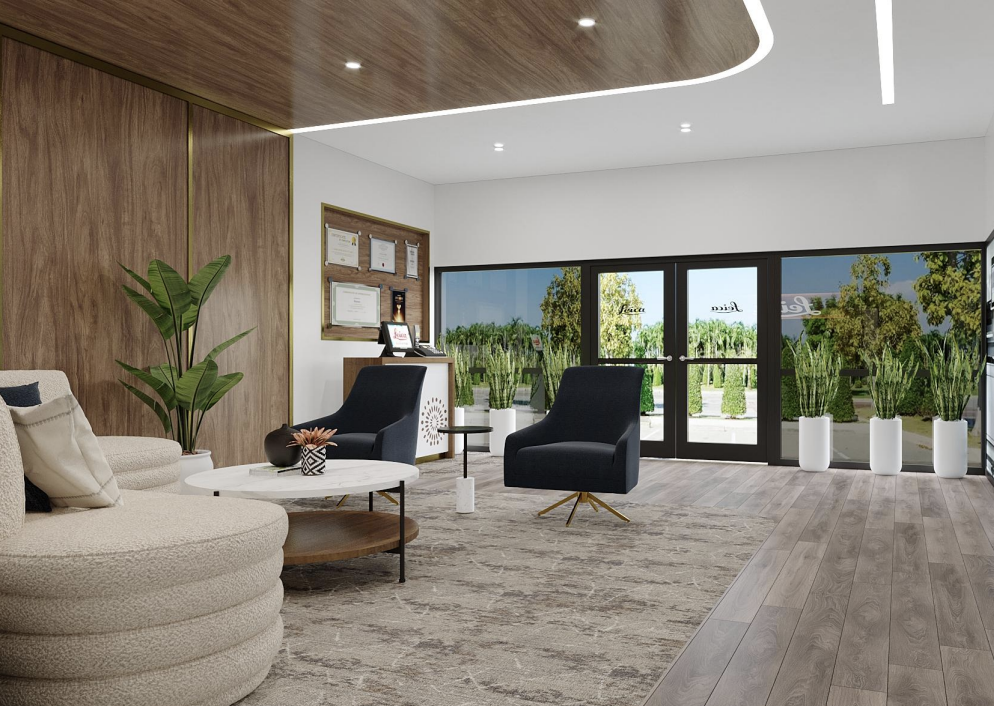
Commercial interior design asks a bigger question: What should this environment become?
That can include space planning, but also:
The objective isn't simply to fill a floor plan. It's to create one cohesive environment.
We're big believers in choosing the right resource for the job.
If you already know what you need, are working within an existing office that isn't changing significantly, need furniture quickly, or want to take advantage of quality pre-owned inventory, a furniture dealer or showroom may be a very practical choice.
There can be tremendous value in gently used commercial furniture. Companies relocate, downsize and liquidate beautiful furniture every day, sometimes creating opportunities to purchase high-quality products at substantial savings.
For the right project, that makes perfect sense.
Consider starting with a design firm when you're asking questions like:
How should our new office function?
How can we make this dated space feel completely different?
How do we make our office actually feel like our company?
Where should we invest—and where can we save?
How do we coordinate the contractor, finishes, furniture, lighting and dozens of decisions without managing all of this ourselves?
Those are design questions rather than furniture questions.
And that's where our role becomes very different.
At San Diego Office Design, we source furniture as part of an overall design—not the other way around.
Depending on the project, that might mean commercial furniture manufacturers, custom millwork, local craftspeople, specialty pieces or even incorporating existing furniture that's worth keeping.
We don't believe every office needs to be filled with the most expensive option. Quite the opposite.
Good design is knowing where the investment will matter—and where it won't.
Sometimes the right answer is a statement reception desk. Sometimes it's great lighting, an unforgettable conference room or one beautifully branded wall.
And sometimes it's keeping 40 perfectly good workstations and investing the budget somewhere employees and clients will actually notice it.
There's another difference clients don't always consider until they're in the middle of a project: someone has to connect all the pieces.
Our team can begin with the initial concept and carry that vision through space planning, finishes, renderings, technical design, furniture, construction coordination, procurement, installation and the final punch list.
Instead of asking the client to translate a design concept between multiple vendors, we remain the keeper of the original vision.
That means fewer disconnected decisions, fewer opportunities for something to get lost between teams—and a much easier process for the client.
Here's our simplest rule of thumb:
If you primarily need furniture, start with a great office furniture dealer.
If you need to determine what your space should become, start with a commercial interior designer.
Neither approach is inherently better. They're simply designed to solve different problems.
And if you're somewhere in between? That's perfectly normal, too.
At San Diego Office Design, not every client needs our complete design process. Some need an initial concept and direction. Others need furniture and finishes. And some want us to take the project from the first sketch all the way through move-in day.
The goal isn't to sell you more design.
It's to figure out how much design your project actually needs—and then make every decision from there count.
 San Diego Office Design
Proudly based in San Diego, we’ve been bringing West Coast style to clients near & far for 17 years. Woman-owned & Led. (WOSB, DBE) NAICS 541410, 442110 (We sell furniture and services to the government and city, as well as to clients like you!)
Read our latest article about the ins and outs of commercial interior design! Read Here!
